

The Streisand effect (also called the Barbra Streisand effect) is what happens when someone tries to hide or suppress a piece of information and ends up getting far more people to see it. It is real, but it is the exception. Most content that is taken off the internet disappears without anyone noticing, which is why you have never heard of those cases.
I have been removing content for more than ten years. At Nítida AI, before we ask anyone to delete anything, we look at how the request is going to land with whoever receives it. Almost everything depends on that.
What the Streisand effect means and where the name comes from
The name goes back to 2003, when Barbra Streisand sued a photographer who was documenting the erosion of the California coast from the air. One of his thousands of photos showed the singer’s house in Malibu. She asked for 50 million dollars and for the image to be taken down.
Until that day the photo had been downloaded six times, two of them by her own lawyers. The following month it passed 420,000 visits. Streisand lost the case and had to pay the photographer’s legal costs. Mike Masnick gave it the name in 2005, on the blog Techdirt, and it has stuck for any attempt to cover something up that ends up advertising it.
Examples of the Streisand effect
In Britain, the case people remember is Trafigura. In October 2009 the oil trader’s lawyers told The Guardian that it could not report a question an MP had tabled in Parliament about a report on toxic waste dumped in Ivory Coast. The paper published the only thing it was allowed to: that it had been stopped from reporting Parliament. Within hours, bloggers and Twitter users had found the question and were passing the company’s name around. By lunchtime the next day the lawyers had backed down.
In France it happened to the intelligence service. In April 2013 the DCRI, the domestic intelligence agency, summoned a volunteer administrator of French Wikipedia and made him delete an article about a military radio station, under threat of being held in custody. The article had been online since 2009 with hardly any readers. Another editor restored it from Switzerland, and that weekend it was the most-read page on French Wikipedia.
And it doesn’t take a court or a threat. In 2013, after the Super Bowl, Beyoncé’s publicist asked BuzzFeed to swap some photos in which she didn’t look her best. It was a polite email. BuzzFeed published the email, and the photos ended up as memes.
The most recent one is a book. In March 2025 Meta obtained an emergency arbitration order barring a former employee from promoting Careless People, her memoir about the company. The order did not bind the publisher, which kept selling it. The book sold 60,000 copies in its first week.
There is one more that is close to home, because my profession comes out of it. A Spanish citizen asked Google to stop showing, when his name was searched, two notices that the newspaper La Vanguardia had published in 1998 about the auction of a property over social security debts. He won. The Court of Justice of the European Union ruled in his favour in 2014, and that judgment is the source of the right to be forgotten that anyone can use today. But the judgment tells his story, and anyone who studies the right to be forgotten starts by reading about that auction. I am not going to put his name here.
Why the Streisand effect happens
A removal doesn’t draw attention. What draws attention is the attempt, when there is a story in it. It takes someone who wants to tell it, usually the author or a community that sees the request as proof it was right. And it takes something that can be shown, like a lawsuit or the removal request itself. If people are already following the matter, it goes viral.
When those things aren’t there, which is the norm, the content comes down and nobody notices.
When asking for removal makes it worse
Our first option is always to remove the content from the website where it is published, because that is the only thing that takes it down everywhere. And asking for removal doesn’t mean writing to the author: there is almost never just one party to go to.
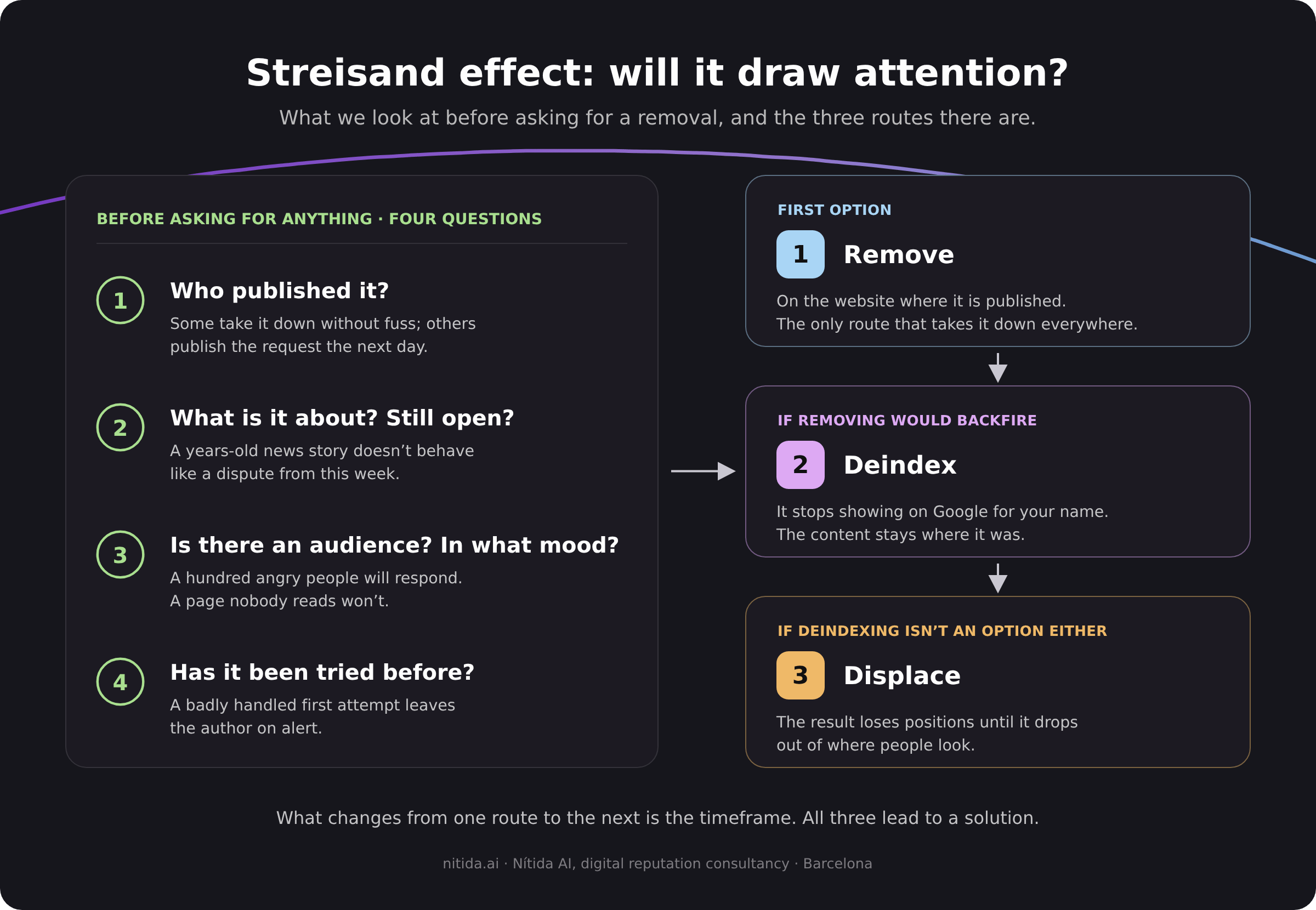
But there are cases where it isn’t worth trying, and you can usually see them coming. We don’t look only at the page. We look at the whole situation:
- Who published it and how they react when someone writes to them. Some take it down without fuss; others publish the request the next day.
- What it is about and whether the matter is still open. A news story from eight years ago behaves differently from a dispute from this week.
- Whether there is an audience, and what mood it is in. A hundred angry people in a thread will respond; a page nobody reads won’t.
- Whether it has been tried before. A badly handled first attempt leaves the author on alert.
In big cases we measure before giving an opinion
When the client is well known or the matter has spread on social media, an impression isn’t enough. We measure the tone of what is being said on social networks and forums, and that gives us a reading of where the public stands and what the risks are.
That measurement shows things you miss reading page by page. For example, that half of what has been posted comes from the same user. What looked like an angry public is then one person with something personal against the client, and the case has to be approached differently.
We share what we see with the client before proposing anything. It is almost always the client who joins the dots: they know who it might be and what happened before. They hadn’t mentioned it because nobody had asked them the right questions.
What we do when removing would backfire
We don’t drop the case. We move to the next route.
The first is deindexing: asking the search engine to stop showing that result when your name is searched. The content stays where it was, but it stops being found. The request goes to Google, not to whoever published it. Google lets the website know that a result has been removed, but not who asked.
If deindexing isn’t an option either, there is displacement: working so that the result loses positions until it drops out of where people look.
What changes from one route to the next is the timeframe. All three lead to a solution. They are explained in more detail in Can a news article be removed from Google? and on our content removal page.
What you don’t see
The Streisand cases you know are the ones that went wrong. The ones that go well never make the news, and there are far more of them.
Some routes leave a trail all by themselves. Copyright complaints sent to Google end up in Lumen, a public database that records who is complaining and against which website. Choose the wrong route and you can leave in writing exactly what you wanted gone.
That is why our removal cases usually come with six months of monitoring afterwards. If the attempt leaves any trace, we see it and deal with it.
Three typical cases, no names
The request that got published
By the time the client came to us, the problem had already grown. A removal request had been sent earlier to the person publishing the case. The reply was to publish the request and, while they were at it, retell the whole court case. Where there had been one piece of content there were now two, the second more recent.
The thread with the author in it
A forum, a thread of complaints about a company, and the author replying every day. Writing to the author would have handed over material for the next post. We took a route that didn’t go through them.
The news story nobody read
A story in a local outlet, years old, about a matter long closed. No comments, nobody following it. Removal was requested from the website and it disappeared without a sound. It is one of the common cases.
How to avoid the Streisand effect before asking for anything
You avoid the Streisand effect by not giving anyone a story to tell: no public replies, no threats, and a removal route that doesn’t go through the person who published the content. Before asking for anything:
- Don’t reply in public: not in the thread, not in the comments, not on social media.
- Don’t send threats. The first email is the one the author will show around.
- Keep evidence, but privately: a screenshot with the date and the address. Don’t save it to public web archives, because that copy is one more piece of content that will have to be removed later.
- Have someone assess the case before you take the first step. A badly made attempt can’t be undone.
If there is content that is harming you and you don’t know whether to touch it, tell us your case before writing to anyone. If you would rather know first everything that is published about you, that is the digital exposure audit.
Frequently asked questions
What is the Streisand effect?
It is what happens when an attempt to hide a piece of information ends up spreading it further than it had ever gone.
Why is it called the Streisand effect?
After Barbra Streisand, who in 2003 sued a photographer to have an aerial photo of her house taken down and got hundreds of thousands of people to look at it. Mike Masnick coined the name in 2005.
What is the opposite of the Streisand effect?
There is no agreed name for it. In practice the opposite is what happens most of the time: content is taken down and nobody notices. Nobody writes about a removal that worked, which is why it has no name.
I asked for content to be removed and they published my request. What do I do?
Don’t reply and don’t send a second request. Keep evidence of both publications. The new one can be dealt with too, but not by writing to the same person again.
Can a right to be forgotten request trigger the Streisand effect?
Rarely. The request is made to the search engine. The website gets a notice that a result has been removed, without the name of whoever asked.
Can a lawsuit end in a Streisand effect?
Yes. A lawsuit is public and hands a headline to anyone who wants to tell the story. Sometimes it is necessary, but it is worth knowing that before filing.
Is it better to do nothing about content that harms you?
Almost never. What you leave alone stays there, and now AI systems read it too and summarise it alongside everything else. I explain this in What ChatGPT says about you.
Sources: California Coastal Records Project and Techdirt (2005) for the Streisand case; The Guardian (13 October 2009) for Trafigura; The Guardian (7 April 2013) and PCWorld (8 April 2013) for French Wikipedia; Techdirt (2013) for Beyoncé; Associated Press (21 March 2025) for Careless People; judgment of the Court of Justice of the European Union of 13 May 2014, case C-131/12.