

ChatGPT doesn’t search your name: it summarises it. When someone asks who you are, it gathers what it has read about you on public pages (news, directories, profiles, the odd forum) and turns it into three paragraphs with the tone of a fact sheet. If what is published is incomplete, old or mixes two people with your name, the answer comes out just as confident and just as wrong. Google, at least, shows ten links and lets the reader decide; AI decides for them. And there is one thing almost nobody mentions, and that took me a while to accept: part of what AI knows about you cannot be erased. Only hidden. Since 2023 I have asked AI systems about the people I work with before doing anything else, and two things keep coming up: what you see on your screen is not what the person asking about you sees, and arguing with the model is a waste of an afternoon.
How to check what it says about you (and how not to)
What almost everyone does is open ChatGPT in their own account and type their name. That shows one version, yours: your account’s memory, what you have asked it before and the language you write in all shape the answer. A client, an investor or a journalist has none of that. To see what they see, you have to ask the way they do:
- Logged out, or with a clean account that doesn’t know you.
- With and without browsing. With browsing on, the model searches in the moment and tends to give the latest; without it, it answers with what it learned in training, which may be one or two years old. Both versions are in circulation.
- In several languages. In English, many AI systems draw on different sources and tell a different story.
- With the questions someone else would ask, not the ones you would. “Who is [name]?”, “Is [name] reliable for [your field]?”, “Who are the best [your sector] in [your city]?”. The third one hurts the most: the answer often cites five competitors and you are not there. I have seen it happen to firms with twenty years of history.
- Several times. Answers change from one run to the next. What matters is what repeats.
And not only ChatGPT: Gemini, Copilot, Perplexity and Google’s AI Overviews all answer differently. What matters is what they repeat.
The two memories of an AI (and why one can’t be erased)
This is what I explain in the first meeting with any client, because it changes what they expect. A model like ChatGPT has two ways of “knowing” things about you, and they are not handled the same way.
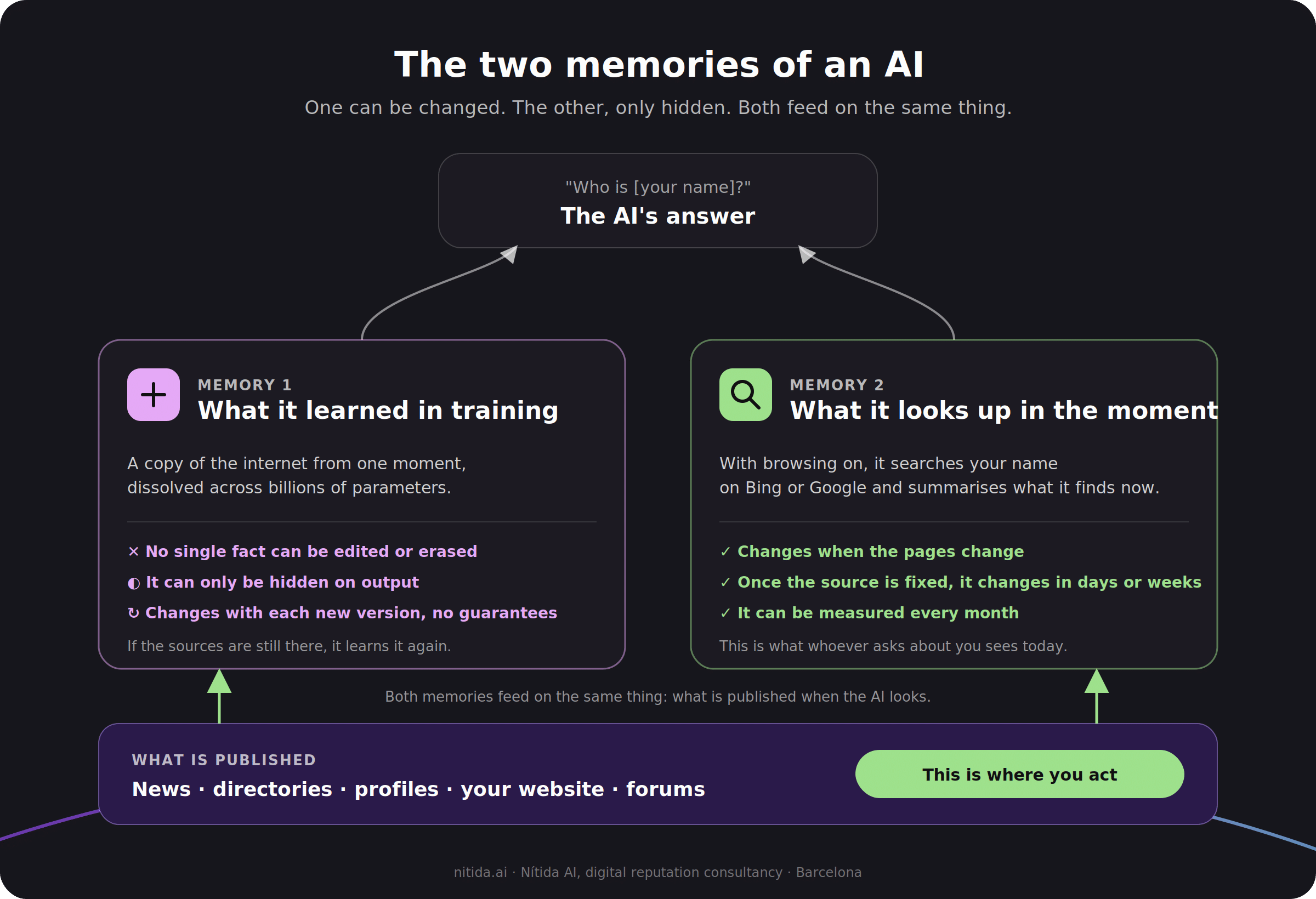
What it learned in training. The model is built by reading an enormous copy of the internet taken at a specific moment. Whatever was published about you at that point stays inside the model, not as a file that can be opened and corrected, but dissolved across billions of parameters. Nobody, not even the maker, can go in and delete one specific fact. The only thing they can do is put a filter on the output so it isn’t shown, which is what happens when they accept a request: the data is still inside, hidden. That knowledge stays until a new version is released, trained on a more recent copy of the internet; and even then there is no guarantee it disappears, because if the sources are still published it learns it again, and because a new model sometimes inherits things from the previous one.
What it looks up in the moment. With browsing on, which is now the norm, the model searches your name on Bing or Google before answering and summarises what it finds now. This part does change when the pages change: once the source is corrected, the answer changes within days or weeks.
With that, the strategy decides itself, even if it is the opposite of what instinct says. Arguing with the model doesn’t work. Asking the maker to “erase” doesn’t erase: it hides. What truly changes what the AI will say, today and in its next version, is what is published when it looks again. That is why the work starts at the sources, and why we measure every month with the same questions: to know whether the new version has learned what it should or is still on the old story.
Why it gets it wrong
The errors are not random. In the cases I have seen, almost all fall into one of four types, and it helps to know which is yours because each one is fixed differently:
The namesake. Two people with the same name, and the model merges them into one. The lawyer in Valencia inherits the conviction of the builder in Murcia. It is the most frequent error with common names and the easiest to spot.
The old title. The model keeps presenting you as the director of a company you left in 2021, because that is the label most often attached to your name. The new one hasn’t been published enough.
The story without an ending. The news of the investigation ran in six outlets; the dismissal in one, or none. AI summarises what repeats most, and what repeats most is the beginning.
The void. There is nothing published about you, or almost nothing, and the model fills the gap with what seems probable. These are the most dangerous answers, because they sound just as certain.
What it almost never is: an opinion of the model. It has none. It has sources, good or bad, and a way of summarising them. One of those sources is Wikipedia; I explain it in How to get a Wikipedia page.
Why it doesn’t match Google
Because they are two different systems reading the same thing. Google ranks links and, since 2014, removes results about individuals when asked with a legal basis; what it removes stops showing on Google, but the page still exists. AI models read the pages, not Google’s results. If an article no longer shows on Google but is still published, the AI can keep telling it. And the reverse: a page Google ranks eighth can be the AI’s main source if it is the one that best “explains” who you are.
Working on Google alone is no longer enough. What changes the AI’s answer is what happens at the sources.
What can be corrected and what can’t
I say it exactly as I say it to whoever calls me:
- What comes from a specific source is corrected at the source. If the outlet updates the article with the dismissal, if the directory changes your title, if the page mixing the two namesakes is corrected or disappears, the AI stops repeating it within weeks or a few months, depending on the model.
- What has no source is covered with sources. A void is filled by publishing what should be read: your version, in the places AI systems use (your website, professional directories, profiles, media). It isn’t marketing; it is giving the model something better to summarise.
- What is false and harms you can be taken up with the model’s maker. The GDPR gives the right to rectify and to erase personal data, and AI providers have channels for requesting it; in Europe there are also complaints under way about inaccurate ChatGPT answers. It works in some cases, it is slow and it requires proper documentation. What it doesn’t do is change what the sources say, so it almost always goes together with the above.
- What can’t be done is erasing what the model has already learned, or guaranteeing what its next version will say. What can be done is making sure that, when it learns again, it finds something else; and measuring it every month with the same questions to know whether it is heading the right way.
Three cases, no names
The partner who didn’t exist
A consultancy asks ChatGPT about its founder and the AI attributes to her a business partner she never worked with. The source was a directory that mixed up two companies with similar names. Once the directory was corrected, the answer changed within six weeks.
The invisible firm
A law firm with twenty years of history asks for “the best commercial lawyers in Barcelona” and does not appear in any of the four AI systems. Nothing bad was published; there was simply nothing. Five months of listings, articles and mentions later, it appears in three of the four.
The dismissed investigation
An executive whose case was dismissed in 2022. Google had already removed the links; ChatGPT kept describing the investigation as open, because two of the outlets had not updated the article. Once both were updated, the AI stopped repeating it.
What to do, and in what order
- Check it properly: logged out, with and without browsing, in two languages, with the questions someone else would ask, and saving the answers.
- Find the source of each error. There always is one, even if it is sometimes on page twelve of Bing.
- Correct at the source what can be corrected; publish what is missing; take up what is false.
- Measure again the following month with the same questions.
If you want to know what AI systems say about you and where they get it from, that is what the digital exposure audit does; and if you already know what is wrong, Reputation in AI explains how we work on it.
Frequently asked questions
Can I ask ChatGPT to erase what it says about me?
You can ask the provider not to show your personal data in its answers, under the GDPR. It is a documented process and not immediate, and it helps to know what it achieves: the maker cannot erase what the model learned, only stop showing it. And it does not touch the sources it got it from: if they are still published, you have to act on them too.
If a new version of ChatGPT is released, does what it said about me disappear?
It isn’t guaranteed. The new version learns from a more recent copy of the internet; if the sources are still there, it learns it again, and it sometimes inherits things from the previous model. The only thing that ensures a change is that the sources have changed first.
Why does ChatGPT give me a different answer every time?
Because it generates the answer in the moment, and because with browsing on it searches again every time. What matters is not one isolated answer but what repeats across several.
Do AI systems read what Google has removed under the right to be forgotten?
They can. The right to be forgotten in search engines takes the result out of Google, but the page is still published and models read pages. For an AI to stop telling something, the effective route is to act on the source.
Does this apply to companies or only to individuals?
To both. With companies, the usual problem is that the AI doesn’t mention you when people ask about your sector, or that it mixes your company up with another. The work is the same: sources, mentions and measurement.
How long does it take for an AI’s answer to change?
What depends on a specific source, between weeks and a few months after correcting it. Getting a model to start mentioning you in sector questions usually takes three to six months.
Sources: Regulation (EU) 2016/679, Articles 16 and 17 · OpenAI’s help page on privacy requests · noyb’s page on its complaints against OpenAI (2024-2025) · Google’s documentation on AI Overviews.