

To get a Wikipedia page, independent publications have to have written about you in some depth, someone has to write the article neutrally, and whoever writes it can’t hide who they are. Wanting one isn’t enough. And if you already have a page and it says something untrue, it can be fixed, although the quickest way to make it worse is to edit it yourself.
Some people ask for “their Wikipedia profile” the way they would open a LinkedIn account. Wikipedia doesn’t have profiles. It has encyclopedia articles, written and watched over by volunteers, under rules that look nothing like a social network’s. Each language edition has its own, and this note is about the English one. Here is what it actually takes, why almost every page people create about themselves gets deleted, and what to do if yours says something wrong.
What it takes to get a Wikipedia page
The English Wikipedia has a guideline for this, the general notability guideline. A subject is presumed to deserve an article when it has received significant coverage in reliable sources that are independent of the subject. Significant means the source deals with you directly and in detail, not that it quotes you in a list or mentions you in passing. Independent means you didn’t write it, pay for it or commission it, and neither did anyone connected to you.
There is no minimum number of sources. The guideline says multiple sources are generally expected, and several pieces from the same publication count as one. They don’t have to be online or in English, which matters if most of your coverage is in Spanish, German or French. In practice you can tell quickly whether you have them: if you can’t write the first paragraph of your article without your own website, your press release or your LinkedIn, you don’t have a page yet.
Counts: features and profiles in publications with their own editorial staff, books from established publishers, academic studies of your work, awards that were covered by the press.
Doesn’t count: your website, your social media, press releases (even if ten sites reprint them), sponsored content, interviews where only you speak, company directories.
Wikipedia doesn’t make you notable. It records it once you already are, somewhere else.
Why pages people create about themselves get deleted
On the English Wikipedia, most of them never reach the encyclopedia. A new account can’t create an article directly until it is four days old and has made ten edits, and anyone with a conflict of interest is expected to write a draft and submit it for review instead. If the draft is declined and nobody touches it for six months, it is deleted. If it is purely promotional, it can be deleted on sight, with no notice period. The same goes for an article about a person that doesn’t say why they matter. The slower routes are a proposed deletion, which goes through after seven days if nobody objects, and a deletion discussion, which usually runs for a week.
The numbers back this up. Between 17 September and 17 October 2026, the English Wikipedia logged 9,246 article deletions. Leaving aside 3,564 technical ones (redirects and housekeeping), 5,682 remain. More than half went through a deletion discussion or a proposed deletion, which in most cases come down to notability. And more than a third, 2,071, were articles written with AI. In the same month 8,914 drafts were deleted as well: 5,679 because nobody had touched them in six months, and 692 as promotional. It is all in the public deletion log, and anyone can repeat the count.
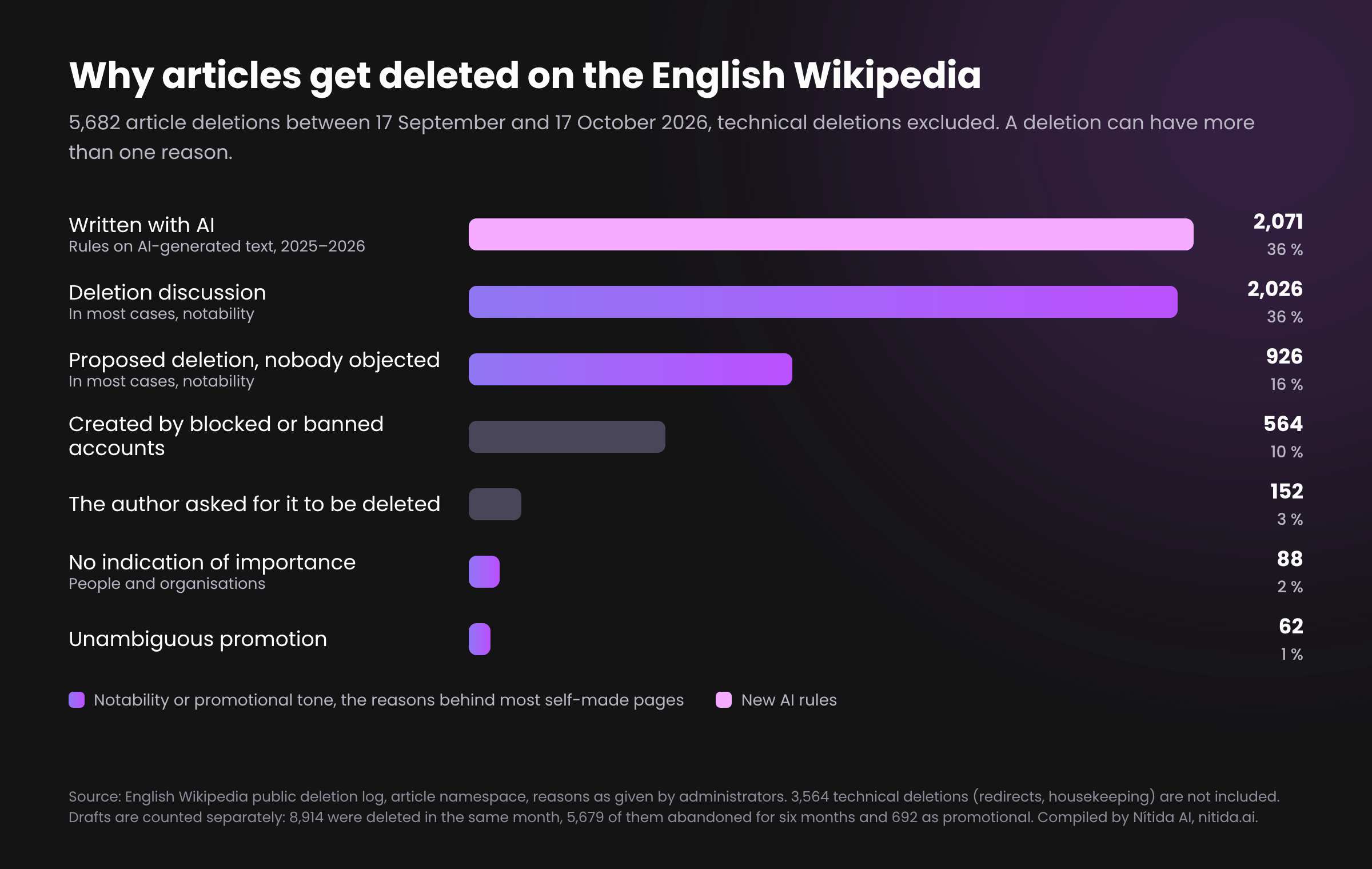
Pages written by the person themselves, their company or their agency tend to end in one of those ways. The person may have plenty of merit; what fails is the text, and it shows: “leader”, “visionary”, “award-winning”, lists of services, achievements no source supports. On top of that, Wikipedia strongly discourages editing about yourself, your company, your employer or a client. It calls this a conflict of interest. And every article’s history is public, so anyone can see who created it and when.
Two more rules are worth knowing. The English Wikipedia prohibits using AI to write or rewrite articles. A page with the telltale signs, such as invented references or leftover chatbot text, is deleted straight away. And once an editor has been found to use AI, every article they created can be proposed for deletion as a batch, without being reviewed one by one. In that one month, a single account accounted for 744 of those deletions. The other rule: recreating a page that was deleted after a discussion, without fixing what sank it, is also grounds for speedy deletion.
What nobody tells you before you ask for a page
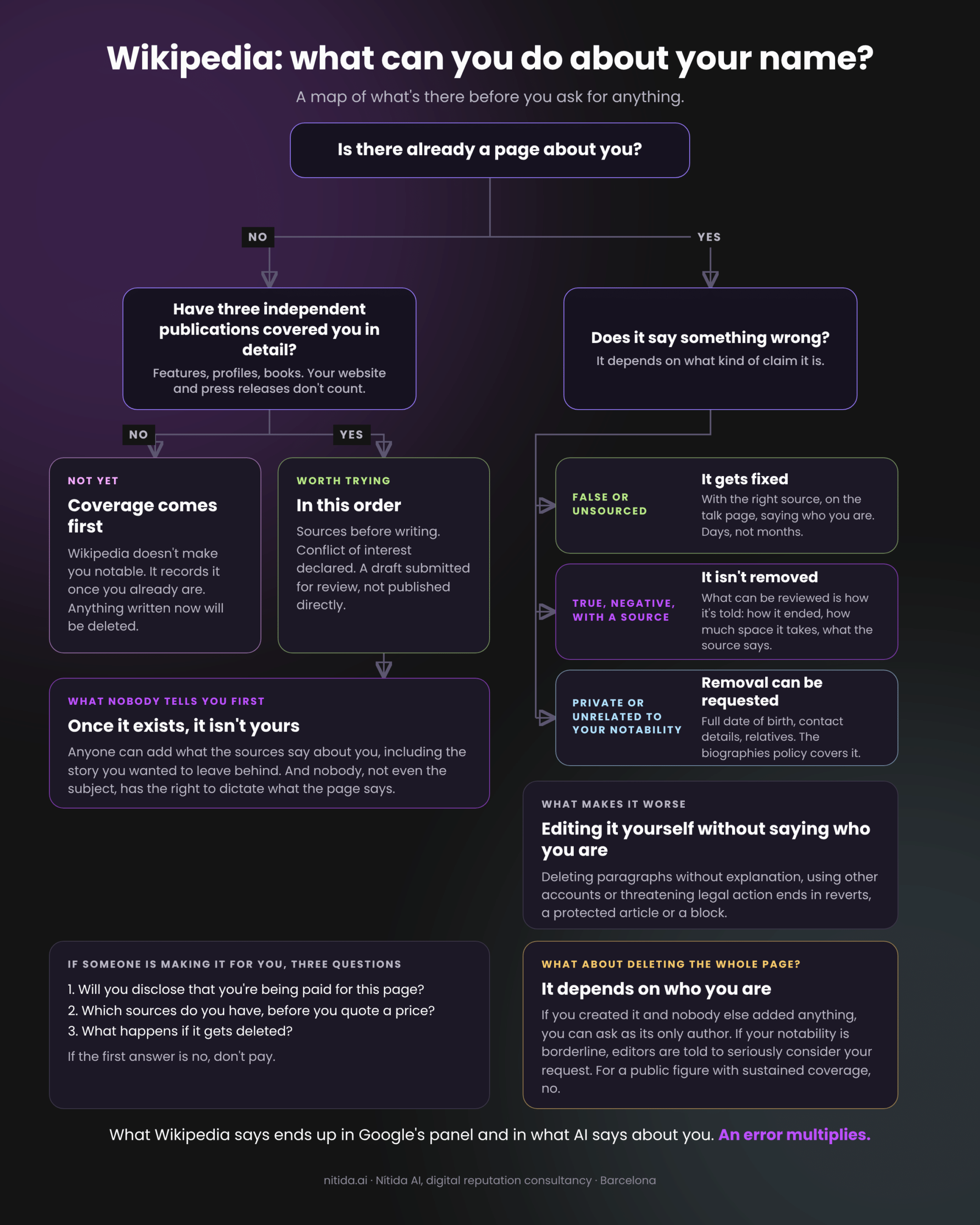
Once it exists, the page isn’t yours.
Wikipedia says so itself in its conflict of interest guideline: nobody, neither the subject nor whoever created the article, has the right to dictate what it says. Any editor can add what the sources say about you, and the sources about you are the same ones that come up when someone searches your name on Google. For public figures the biographies policy is explicit: if an incident is noteworthy, relevant and well documented, it belongs in the article, even if it is negative and the subject dislikes any mention of it.
So before you want a page, look at what would go in it. For some people a Wikipedia page works well. For others it becomes a permanent shop window for what they wanted to leave behind. If that sounds familiar, read Can a news article be removed from Google? first, because that is what needs sorting out before anything else. And if you would rather know everything that has been published about you before deciding, that is what our digital exposure audit is for.
How to create a Wikipedia page that stays
Check it doesn’t already exist. Search for your name, your company’s and their variants. Sometimes the subject already appears inside a broader article, and a well-sourced section there makes more sense than a separate page.
Gather the sources before writing a line. For each one, note who published it, when, what connection it has with you and how much it actually says about you. The text has to come from the sources, not the other way round.
Declare the conflict of interest. If you, your team or someone you pay is writing it, say so. Wikimedia’s terms of use require anyone paid to edit to disclose their employer, client and affiliation. Declaring it doesn’t mean the article will be accepted. What is certain is that if you hide it and someone finds out, the problem will be bigger than the article.
Write it as a draft and submit it for review. With a conflict of interest, the English Wikipedia expects you to go through Articles for Creation, where experienced volunteers review drafts, rather than publishing directly. Third person, neutral tone, a reference next to every fact and no adjective that doesn’t come from a source. Don’t copy the “About us” page from your website: besides being promotional, it’s a copyright problem. There is no fixed waiting time, and some drafts wait a long while.
Don’t use AI to write it. It is prohibited, and it gets drafts declined and accounts flagged.
And if it gets deleted, don’t insist. Read the reason, fix what failed and, if what’s missing is sources, wait until you have them. Recreating the same page from another account is the fastest way to get both blocked.
How to correct a Wikipedia page that gets something wrong
Here Wikipedia is more reasonable than it seems, but you need to know which of these three situations you are in.
A false or unsourced claim. This is the easiest. The policy on biographies of living persons says that contentious material that is unsourced or poorly sourced should be removed, and the conflict of interest guideline allows very obvious errors to be fixed quickly, including by the subject. A wrong date, a job you never held, a company that isn’t yours: it gets fixed by providing the right source.
A true, negative, sourced claim. A published court ruling, a regulatory fine, a controversy covered by the press. This doesn’t get removed. Wikipedia doesn’t delete verifiable facts because they hurt. What can be reviewed is how it’s told: that it also says how it ended, that it doesn’t take up half the biography if it was a minor episode, that the source says what it is cited for. For people who aren’t public figures, the same policy limits the article to what is relevant to why they are notable.
Private details or details unrelated to your notability. Your full date of birth, your address, your phone number, relatives who aren’t public figures themselves. The policy deals with each of these, and if you object to your date of birth being there, editors are told to give only the year.
All of this is raised on the article’s talk page: say who you are, what is wrong and which source proves it. Editors with a conflict of interest are expected to do it as an edit request, which another editor reviews. If you would rather not edit at all, you can email Wikipedia’s volunteer response team with a link to the article and the details of the problem. What doesn’t work is deleting whole paragraphs without explanation, creating accounts so it looks as if someone else is asking, or threatening legal action. Legal threats usually end in an indefinite block, while a polite report of a legal problem, such as defamation, is acted on quickly.
One more thing. The rules let you remove what has no source, but do it under your own name and explain why in the edit summary. If someone reverts you, don’t remove it again; go to the talk page. Edit wars end with the article protected, and the claim still in it.
When a whole Wikipedia page can be deleted
It depends on who you are and who created it.
If you created it and nobody else added anything substantial, you can ask for it to be deleted as its only author. If someone else created it, it takes a deletion discussion, where editors debate whether the subject is notable. Here the English Wikipedia goes further than most people expect: unless you clearly meet the notability guideline or are a current or former elected or appointed official, editors are told to seriously consider your request. A troubled article history, real harm to you and being notable for only one event all count in favour. And if the discussion ends without consensus, an administrator can close it as delete.
Something similar applies to people known for a single event: a news story, an incident, a video that went viral. Wikipedia isn’t a newspaper, and being in the news once doesn’t justify a biography. For a public figure with sustained coverage, on the other hand, deletion isn’t realistic, and the work is making the page accurate.
Wikipedia page agencies: what to ask before you pay
You can hire help with Wikipedia. What you can’t buy is the result, and it’s worth knowing how whoever offers it works. I would ask three questions.
Will you disclose that you’re being paid for this page? It’s mandatory. If they tell you nobody will know you paid, they are selling you a breach of the rules with your name on it: when it comes out, the page is deleted or tagged, and the history remembers.
Which sources do you have? If they don’t ask you for them before giving you a price, they don’t know whether you are notable. They are charging you to try.
What happens if it gets deleted? Promises of a “guaranteed page”, “live in 48 hours” or “aged accounts that won’t raise suspicion” go against the rules, and you are the one who ends up paying for it. In 2015 the English Wikipedia blocked 381 accounts that belonged to a single ring. The ring went looking for businesses whose drafts had been declined, charged them to get the articles published, and then offered to “protect” the pages from deletion for 30 dollars a month.
At Nítida AI we work on all three fronts: getting a page when there is a basis for one, correcting the one that exists and requesting deletion when it is justified, always within Wikipedia’s rules. When there is no basis, we say so. And what we propose then is building one, so there is real coverage before anyone asks for anything.
Wikipedia, Google and AI
All of this matters more now that Google and AI read Wikipedia. Google builds much of its knowledge panels, the box that appears on the right when you search for a name, from Wikipedia and Wikidata, its sister database. AI models have been trained on Wikipedia and consult it when they answer. What your article says ends up in Google’s panel and in what ChatGPT or Gemini say about you.
A correct page fixes the right facts in all those places at once. An error does exactly the same, but with the wrong fact and the authority of an encyclopedia. I explain it in more detail in What ChatGPT says about you and on our AI reputation page.
Three situations that keep coming up
An executive is about to close a funding round, or about to be in the press, and wants to arrive with their article done. The only sources that cover them in detail are an interview in a trade publication and a piece about a controversy from years ago. With that, the article would have more controversy than career, so it’s better to wait until the new chapter has coverage and write it then.
Another commissioned the page from an agency that didn’t disclose the work. Months later an editor added a section about a news story. He deleted it, it was reverted, he deleted it again, and the article ended up protected with the story inside. Now it appears on Wikipedia, in Google’s panel and in what AI tells people. From there, the way out runs through the talk page and the sources, and it is much slower than if it had been done properly from the start.
And the most common one: an article attributed to someone a company and a position that belonged to another person with the same name. It was raised on the talk page with the source that proved it and fixed within days. When the problem is a mistake, Wikipedia fixes it.
Before you ask for anything
- Search for your name on Google in a private window and look at which sources come up. They are the ones that will decide your article.
- If there aren’t three pieces from different publications that cover you in detail, it’s not time yet.
- If you already have a page and it says something wrong, don’t just edit it. Say who you are and explain it on the talk page.
- If someone is going to make one for you, ask whether they will disclose that they’re being paid. If the answer is no, don’t pay them.
If you don’t know whether you have a basis, if the page someone made for you has become a problem, or if a detail has been published that shouldn’t be there, tell us about your case before you write to anyone.
Frequently asked questions
Can I create my own Wikipedia page?
You can, but Wikipedia strongly discourages it and watches for it. If you do it anyway, say it’s you, write it as a draft and submit it for review instead of publishing it directly. Most pages written by their own subject end up deleted as promotional or left to expire as drafts.
Can I edit my own Wikipedia page?
Wikipedia discourages it but doesn’t ban it outright. You can fix very obvious errors and remove unsourced negative material, as long as you do it under your own name and explain why. Everything else, from wording changes to whole sections, goes to the talk page as an edit request for another editor to review.
How do I get on Wikipedia if nobody has written about me?
For now, you can’t. Wikipedia records what independent publications have already published, and without that coverage there is no article that will last, whoever writes it.
Can I pay someone to create a Wikipedia page for me?
You can hire help, but whoever is paid has to disclose it, and nobody can guarantee the result. If they guarantee it, be suspicious.
How do I correct false information about me on Wikipedia?
With a source that proves the correct fact, raised on the article’s talk page and saying who you are, or by emailing Wikipedia’s volunteer response team. What has no source can be removed. What has one can be corrected or put in context, but it isn’t deleted.
Can I get my Wikipedia page deleted if I ask?
If your notability is borderline and you aren’t an elected or appointed official, editors are told to seriously consider your request. If you are a public figure with sustained coverage, no. And if you created the page and nobody else added anything substantial, you can ask for it to be deleted as its only author.
How long does Wikipedia take to accept or correct something?
There are no fixed deadlines. A simple correction with a source can be done in days. A draft submitted for review has no set waiting time, and some wait considerably longer than others. A proposed deletion gives seven days to object, and a deletion discussion usually lasts a week.
Does what Wikipedia says show up on Google and ChatGPT?
Yes. It feeds Google’s knowledge panel and is one of the main sources for AI models. An error on Wikipedia multiplies, which is why it’s worth checking yours even if you don’t want to change anything.
Sources: English Wikipedia policies and guidelines on notability, criteria for speedy deletion, biographies of living persons, conflict of interest, paid-contribution disclosure, writing articles with large language models and presumptive removal of AI-generated content; the Wikimedia Foundation’s terms of use on paid contributions; TechCrunch (1 September 2015) on the 2015 blocks; and the English Wikipedia’s public deletion log (17 September to 17 October 2026).